
How Making Art Helps You Find Your Way Back to Yourself
Visual journaling is a tool for navigating life's changes — and recovering your sense of purpose along the way.

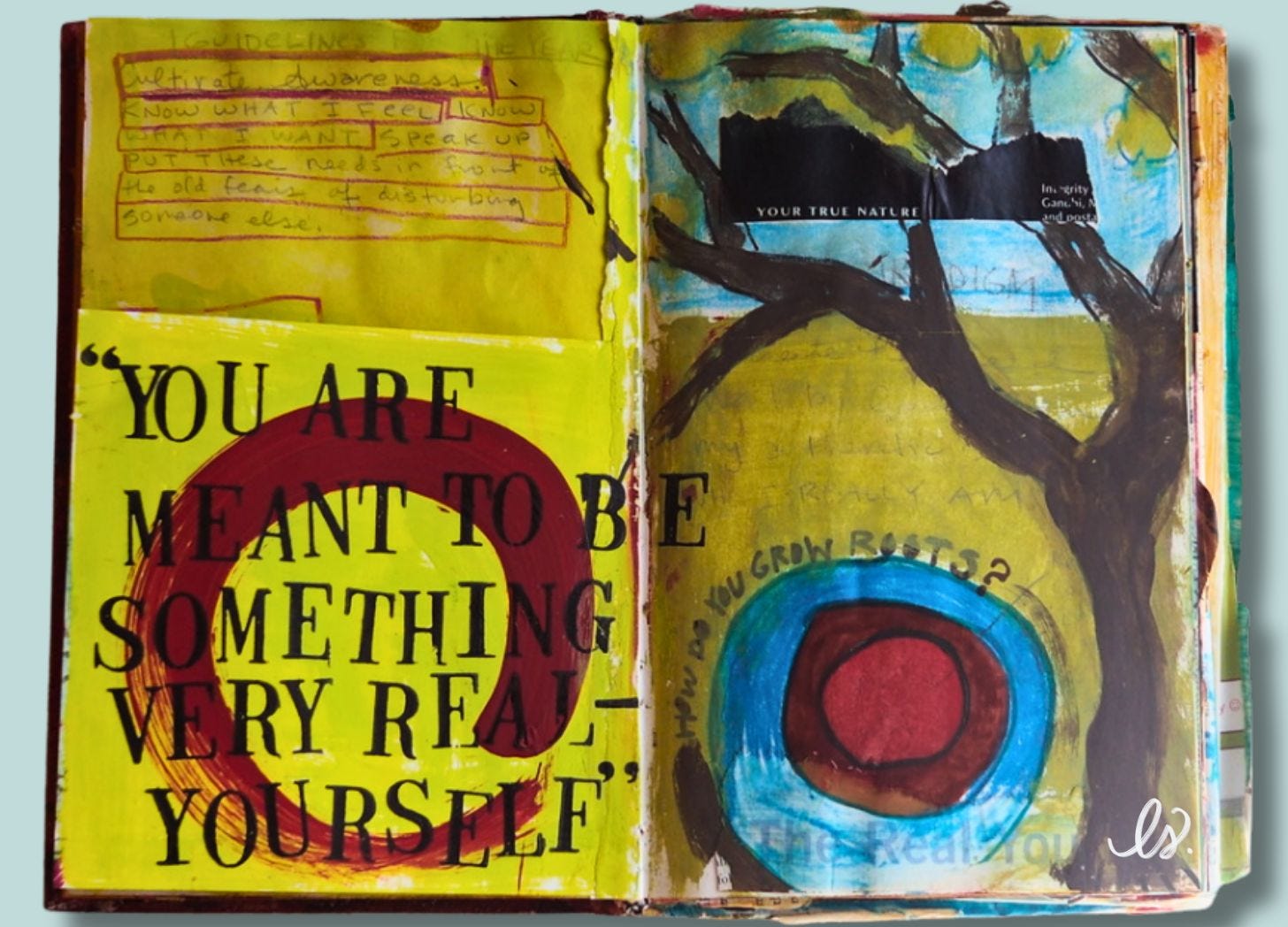
Making art can seem frivolous. Maybe even too fun to count as real work.
And yet — it’s one of the most powerful ways I know to find your way back to yourself when you’re feeling adrift.
Now before you click off and run for the hills because making art scares you — what I’m sharing here is for everyone.
You don’t have to be an artist or have any experience with this.
You don’t even have to know what you’re doing.
And it still works.
You Need A Visual Journal
Swiss psychologist Carl Jung said: “The soul speaks in image.”
When I first came across that sentence, I thought: yes, that’s exactly what we’re doing in a visual journal.
We are plumbing our own depths through image and word together.
What makes keeping a visual journal so practical is that it’s completely portable and private. It happens in a notebook or sketchbook — any size you want.
You close it when you’re done, and it hides in plain sight on the bookshelf with your other books.
No one is watching. And because no one is watching, you get to focus entirely on the process of exploration: trying things out, experimenting, playing.
No need to get bogged down with fancy art materials or technique. All you really need is a notebook and something to write with — a pen, pencil, marker or crayon.
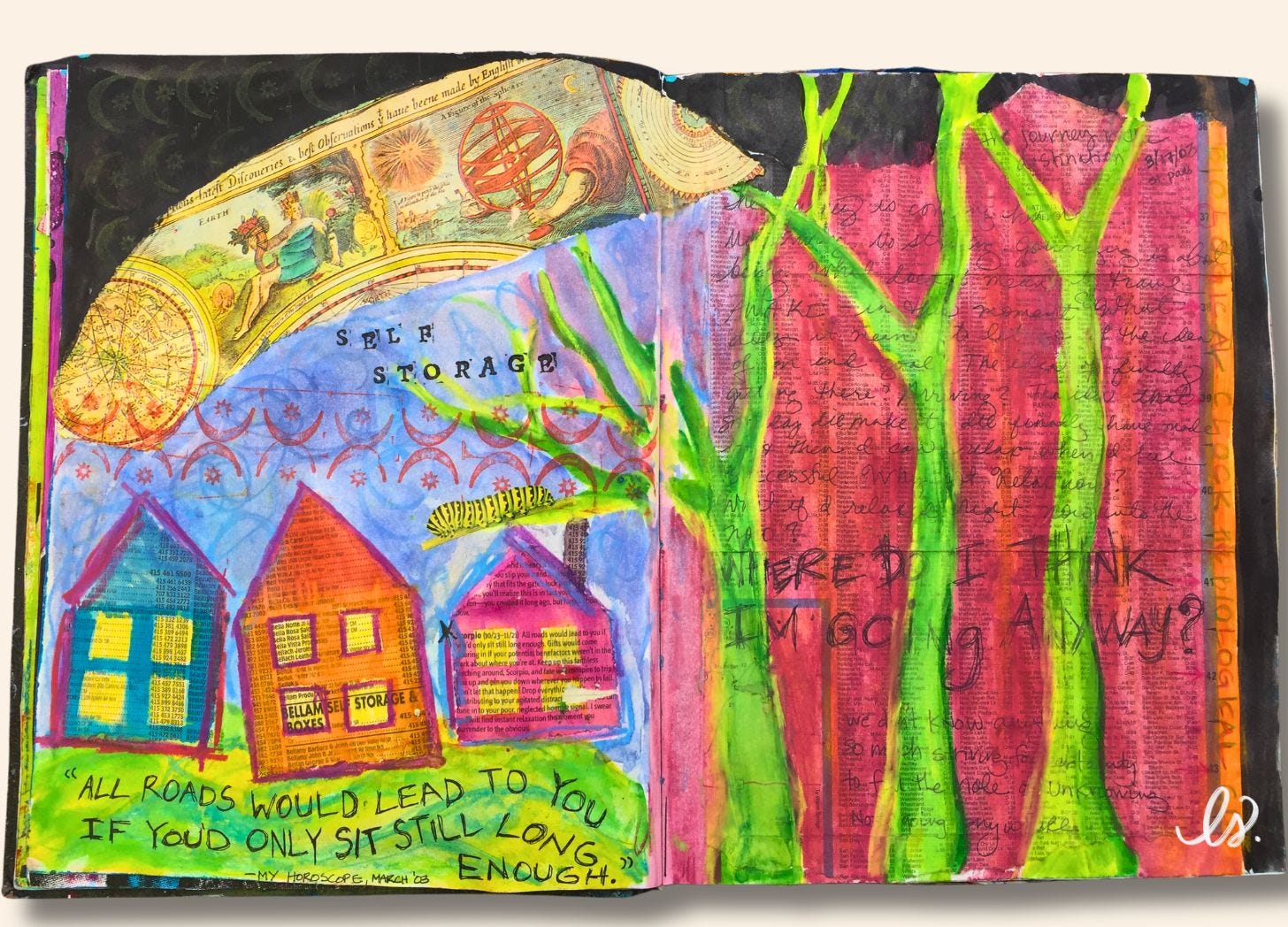
Three T's to get you started
When you sit down with your notebook, you may be wondering how or where to begin, especially when everything is aswirl.
My T-Time framework gives you a way to simplify your visual journaling session with a structure you can use over and over.
Time
Instead of trying to figure out your purpose across the entire span of your life, compress the timeframe into something smaller.
If you’re moving house, focus on the period of packing up and letting go.
If you have a child starting kindergarten or heading off to college, that’s the season.
A season can define the timeframe, such as, Summer 2026. — what does this season mean for you, and what do you want to move through by the end of it?
The year of a milestone birthday.
The point is to chunk time down into a shorter, more workable segment — something you can actually hold.
Topic
Pick one area of life to explore. Not all the things — just one.
It might be a trip you’re taking, a job you’re leaving, a new course of therapy you’ve started.
Maybe you’re going back to school, or becoming a mother for the first time.
Think of your roles, hobbies, or a specific challenge or goal, to name the topic.
When I went to business school — as an artist, LOL— my visual journal was an altered book made from the 1960s title: The Working Girl in a Man’s World.
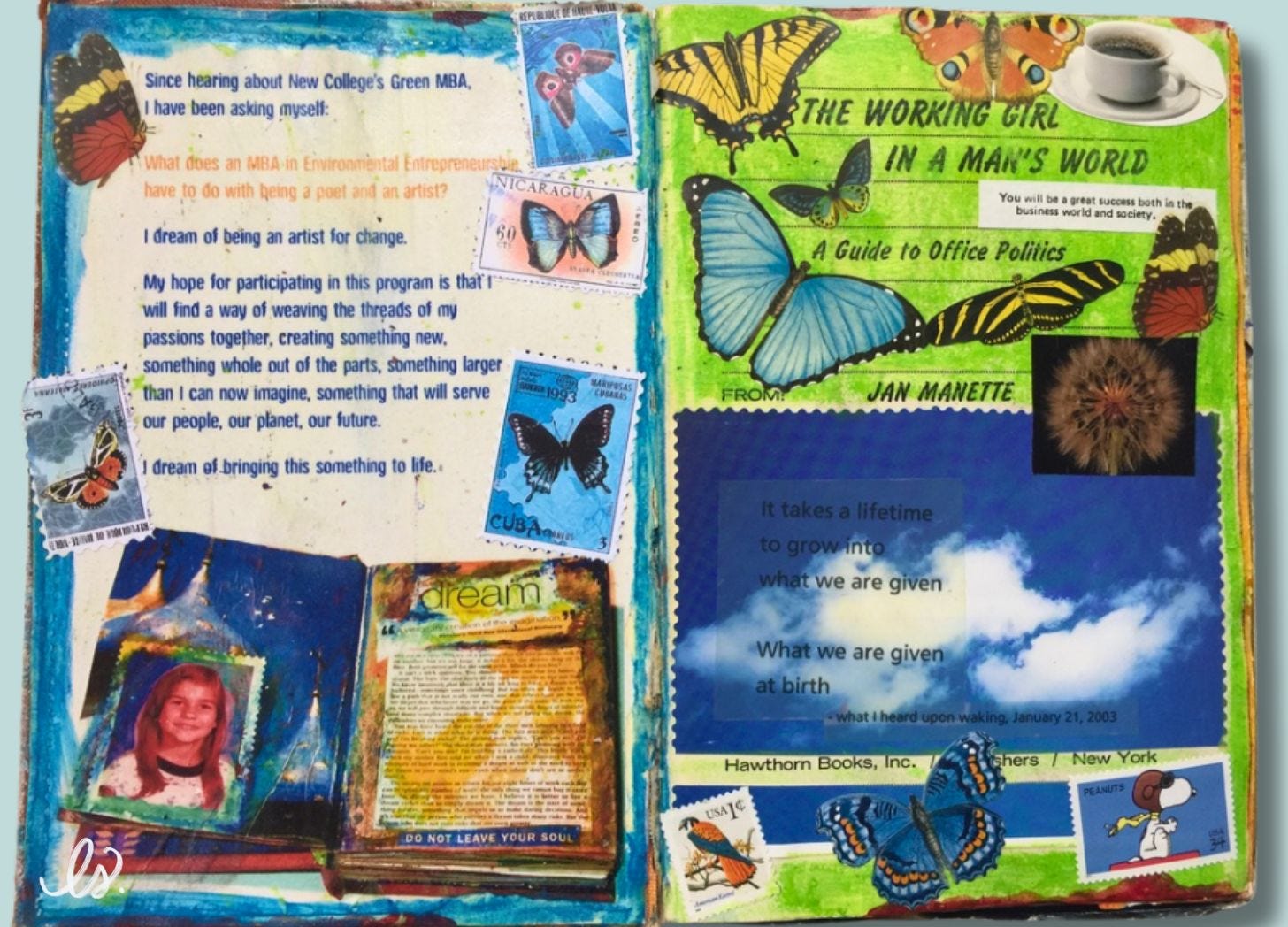
When I found that book at a thrift store around the time my application was accepted, it was the perfect container to capture my experience. Especially since I was a girl born in the sixties.
The topic gave my journal a sense of humor when I was crying in the back row of managerial accounting class.
Transition
Think about what particular transition you’re moving through right now.
A relationship change — kids arriving or leaving, a marriage, a divorce, even a particularly difficult breakup — is a transition. So is a health diagnosis, moving house, a career shift, retirement.
Deciding to come back to your art again is a popular transition among my readers and students.
You’re not trying to make sense of the whole arc.
In your visual journal, all you need to do is locate yourself right where you are and ask: What am I going through? How is this affecting me right now? How do I want to navigate it?
Transitions leave a paper trail of photos on your mobile phone, but also receipts and documents.
All of that is wonderful collage material, ephemera you can fold into the journal.
Plus A Pot of Actual Tea
Put the kettle on. Brew something you love. Cozy up with your visual journal and be surprised and delighted by what starts showing up on the page.
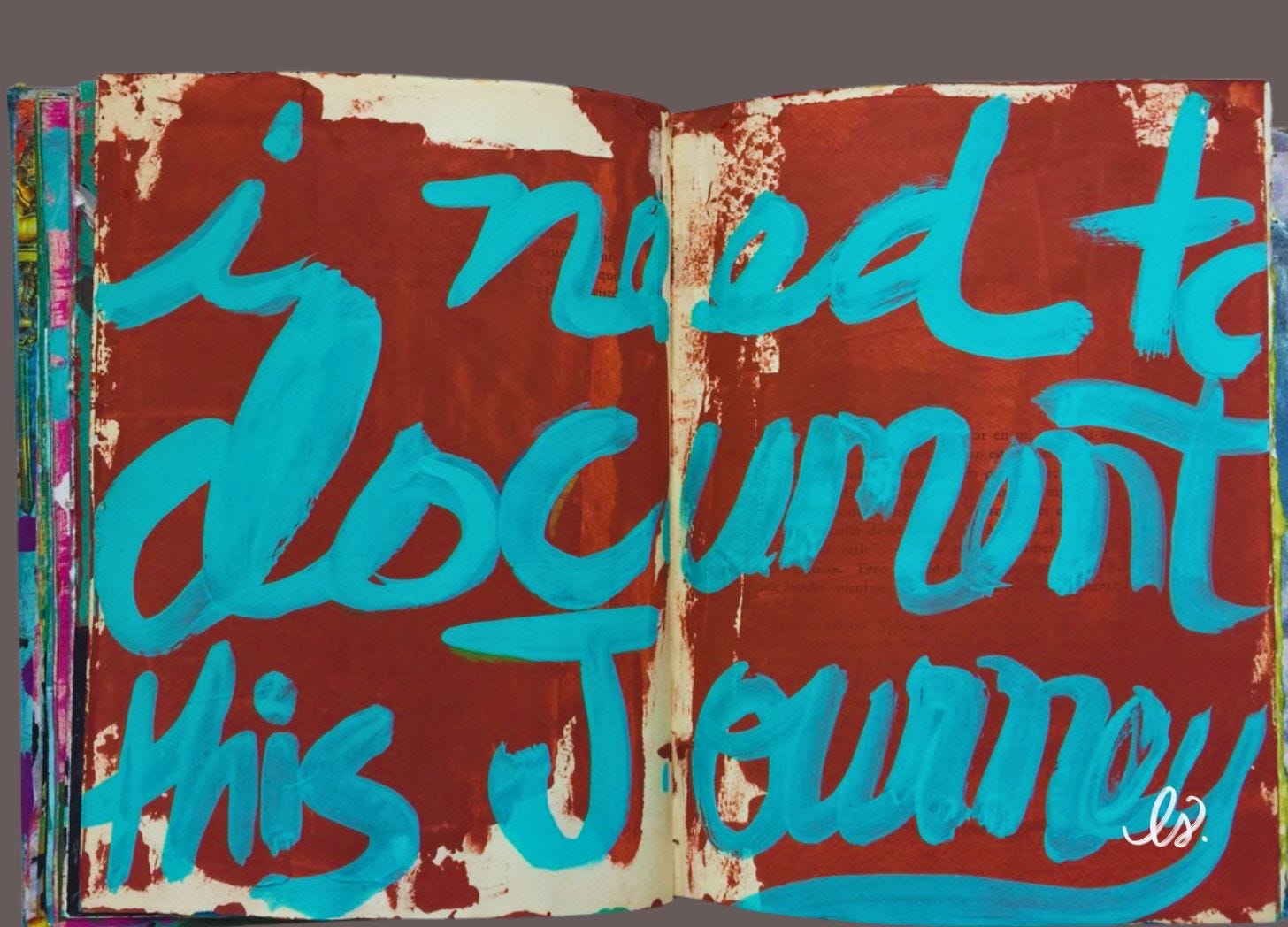
And Then Something Shifts
What I love is how these three T’s work together: compress the timeframe, pick the topic, name the transition.
Suddenly the overwhelming becomes navigable.
Your inner wisdom has somewhere to go.
And I don’t really know how else to describe what happens next other than — it’s just kind of magical.
When you get quiet and turn to your visual journal, you start to know yourself better. What you’re feeling, what you’re thinking, what actions you’re taking or not taking.
I think of the visual journal as a guidebook to the soul. The missing manual, as it were, that we can create as we muddle our way through the unknown. Again.
Come Make Art With Me
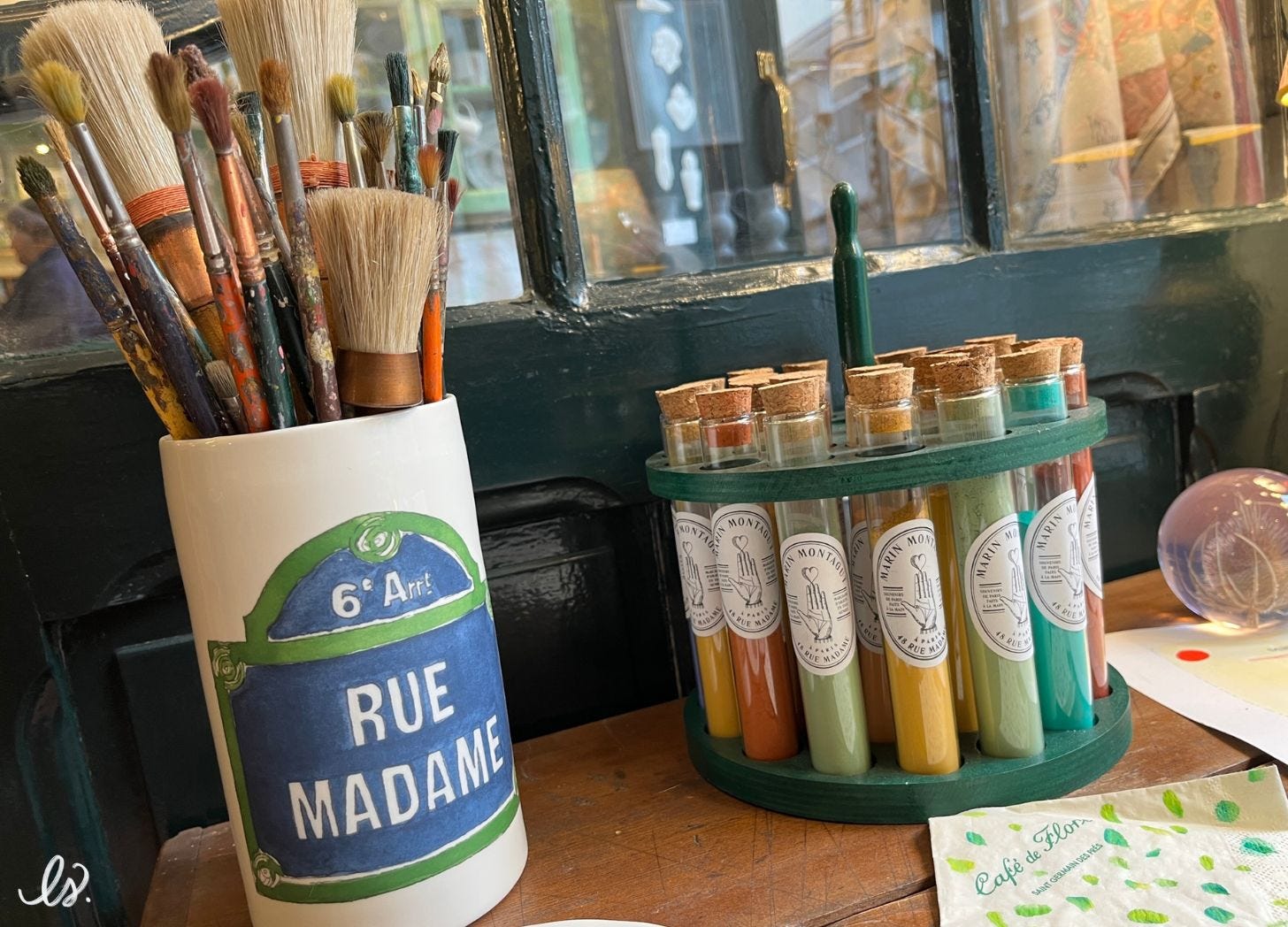
If you want to take your creative practice somewhere beautiful and meaningful this summer, I have space available in two upcoming workshops this June.
Creative Practice Week in Paris (June 14–19) is six days of café life, purposeful wandering to absorb the beauty and artFULLness of Paris, and visual journaling in a small group of five. No experience necessary. Learn more →
Voice & Vision in Frascati, Italy (June 23–27) is a five-day contemplative workshop combining visual journaling with voice work, held in a historic museum near Rome. Co-led with vocal guide Gudrun Bühler. Also no experience required. Learn more →
Both workshops have very limited spaces. If either is calling to you, now is the time.
Along with today’s newsletter, I made a video talking through these ideas when I lived in Mexico. Enjoy!
Thank you for this well-written and absorbing article.
You gave a name to something I've been doing for the past month or so. It's as rewarding as you say it is.
As someone who both writes and paints, I love integrating both visual and verbal thinking in a single book. Your tips will help me take this practice even further.
Thank you Lisa for sharing the three T’s to work with. It helps immensely to separate my visual journals into separate containers. It allows my brain to settle on one thought process at a time. I keep journals for all my courses and one for the current season. 🥰